A piano can be mechanically healthy and properly tuned yet still sound too hard or bright for its room. Voicing is the careful process of changing the tonal character of the hammers so that the piano responds with a more balanced range of color. It is different from tuning and should be approached conservatively.
Tuning and voicing solve different problems
Tuning adjusts string pitch. Voicing changes how the hammer excites the string. If unisons beat or intervals sound wrong, the piano needs tuning. If the pitches are correct but the tone is harsh, metallic, uneven, or tiring, the hammers and room may need attention.
Why a piano becomes excessively bright
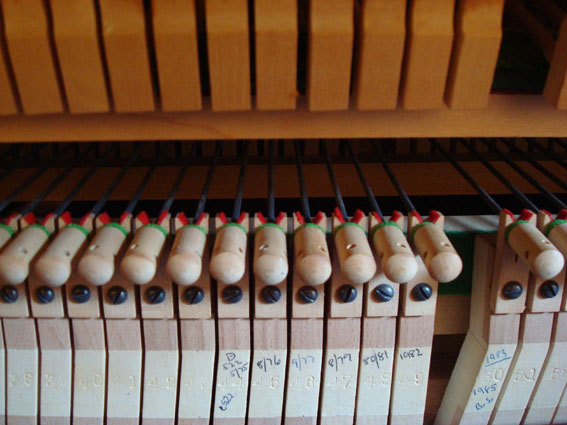
Hammer felt can arrive firm from the factory, harden with age, or become compacted by repeated impact. Deep string grooves reduce the rounded contact surface and can make individual notes sound aggressive. A reflective room with tile, glass, and bare walls can exaggerate the same effect.
Before altering the hammers, a technician should check tuning, hammer alignment, string seating, action regulation, and room acoustics. Voicing cannot compensate for every mechanical or environmental problem.
How technicians soften tone
Depending on the hammer and the desired result, a technician may reshape worn shoulders, lightly needle selected areas of felt, or use a purpose-made softening treatment. The work should progress gradually while the piano is played and compared across registers.
The goal is not to make every piano dull. A successful voicing preserves clarity and projection while making soft playing easier and reducing brittle peaks. Concert pianists may prefer a brighter instrument because refined touch can control it; many domestic rooms feel more comfortable with a warmer baseline tone.
Why restraint matters
Hammer felt cannot simply be restored by reversing every voicing decision. Excessive needling or chemical treatment can remove focus, shorten sustain, or create uneven notes. That is why an experienced technician works in small stages and stops to listen frequently.
What the owner can check first
- Close the lid or adjust its opening and listen again.
- Add rugs, curtains, or upholstered furniture in a very reflective room.
- Confirm that the piano has been tuned recently.
- Notice whether the brightness affects the whole instrument or only certain notes.
- Record the piano from several positions; the bench can sound different from the room.
A more expressive instrument
Good voicing gives the pianist a wider expressive range rather than one fixed “mellow” sound. The instrument should whisper without losing definition and grow in power without becoming painful. If your piano feels too bright, ask Roberts Pianos Houston about an evaluation, browse our available pianos, or read more piano-care guidance.
Evan Roberts
Owner of Roberts Pianos Houston and connected to Roberts Pianos Houston Oxford. 4th generation in the piano trade with a BA and MMus in Music. Passionate about preserving the rich history of piano manufacturing and sharing insights with music enthusiasts worldwide.