Spinet pianos are compact, familiar, and often inexpensive. They can also be among the most difficult upright pianos to service well. Roberts Pianos Houston does not reject every spinet automatically, but we rarely buy or recommend them because the design creates compromises in touch, tone, access, and repair cost.
What makes a piano a spinet?
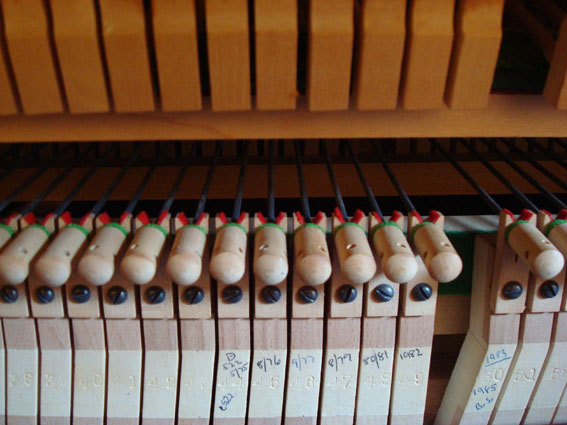
A spinet is a very short vertical piano, commonly around 36 inches tall. To fit the action inside the low cabinet, manufacturers placed much of the mechanism below the backs of the keys. This is called a drop action. Long rods and elbows connect each key to the action beneath it.
In a conventional console or studio upright, the action sits above the backs of the keys. A technician can remove it relatively directly, carry it to a bench, and reinstall it after repair. Many adjustments can even be observed while the action is still in the piano.
Why the drop action complicates repair
On a spinet, the connecting rods and elbows must be managed before the action can be removed. Depending on the design, dozens of connections may need to stay organized or be reattached individually. The action can be repaired on the bench, but it often has to be reinstalled before the technician can fully test the result.
If an adjustment is slightly wrong, the action may need to come out again. A repair that would be straightforward on a taller upright can therefore require considerably more labor on a spinet. The parts themselves are not always unusual; access to them is the problem.
Touch and tonal limitations
The shorter key and indirect linkage can reduce leverage and make the touch feel less immediate. The compact case also means shorter strings and a smaller soundboard. Designers worked hard to obtain a useful sound from a small cabinet, but the bass and dynamic range generally cannot equal those of a good console, studio, or full-size upright.
This does not mean every spinet sounds unpleasant. Some Baldwin Acrosonics and other well-made examples have a warm, charming tone. Condition matters. A particular spinet may be enjoyable for casual playing when it is structurally sound and priced appropriately.
Why a “free” spinet can become expensive
The purchase price is only one part of piano ownership. Moving, tuning, cleaning, regulation, broken plastic or wooden elbows, worn action parts, and structural repairs can quickly exceed the piano’s market value. Bridge separation, loose tuning pins, or extensive moisture damage make the economics even more difficult.
Before accepting a free or inexpensive spinet, obtain a technician’s opinion and a moving quote. Compare the total cost with a taller used upright that offers more direct touch, better service access, and stronger resale prospects.
When a spinet can still be reasonable
- The instrument is structurally sound and holds a tuning.
- The action works consistently without a large repair backlog.
- The player genuinely likes its tone and touch.
- The piano fits a space where a taller upright will not.
- The total delivered and serviced cost remains modest.
Better alternatives for most buyers
A good console or studio upright usually provides longer keys, a more accessible action, a larger soundboard, and better long-term serviceability. It may occupy nearly the same floor space as a spinet while offering a much more satisfying playing experience.
If you are comparing used vertical pianos, see our available instruments, read more buyer guidance, or contact Roberts Pianos Houston before paying to move a piano that may not be economical to repair.
Evan Roberts
Owner of Roberts Pianos Houston and connected to Roberts Pianos Houston Oxford. 4th generation in the piano trade with a BA and MMus in Music. Passionate about preserving the rich history of piano manufacturing and sharing insights with music enthusiasts worldwide.