Through Oct 15
Free Houston-area ground-floor delivery
Complimentary Houston-area ground-floor delivery on select in-stock pianos through October 15. Visit the showroom by appointment and find the piano that fits your home.
Piano Library
About Charles Walter Pianos Pianos
Most common makes we have sold
Charles Walter
Overview
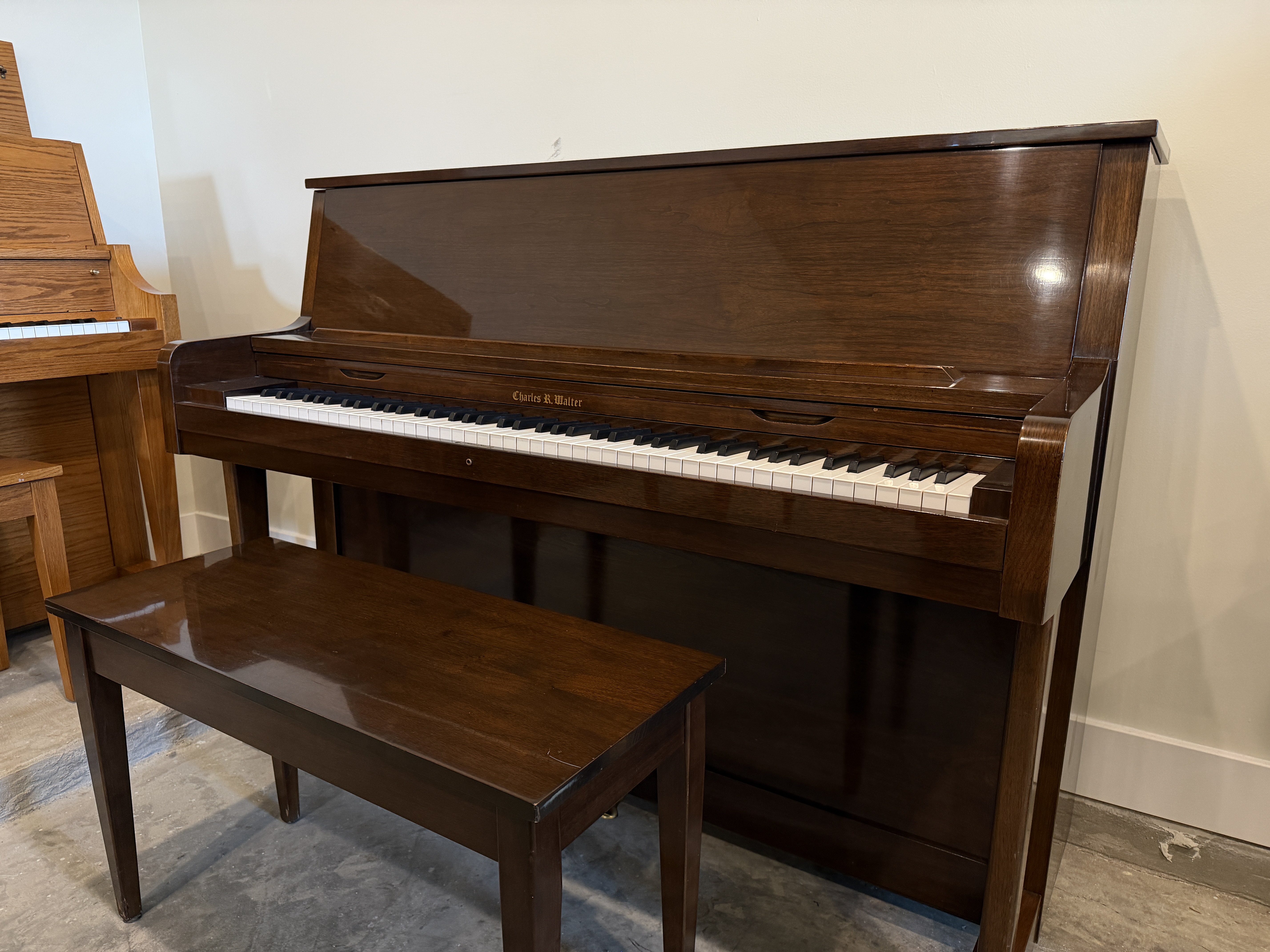
Charles Walter Pianos is a small American piano manufacturer based in Elkhart, Indiana. Founded in the early 1970s, the company is best known for producing high-quality upright pianos built in limited numbers, emphasizing traditional materials, careful workmanship, and long-term serviceability.
Unlike many piano brands that transitioned to overseas manufacturing in the late 20th century, Charles Walter has remained a domestic builder, maintaining a focus on consistency rather than scale.
Family signature
Origins and History
Charles Walter Sr. founded the company in 1972 after working for years within the American piano industry, including experience at Kimball. His goal was not to compete with mass-market manufacturers, but to revive aspects of traditional American piano building at a time when many domestic factories were closing.
The company established itself in Elkhart—historically known as a center of American musical instrument manufacturing—and has remained there since.
From the beginning, Walter pianos were produced in small quantities, with a deliberate emphasis on craftsmanship over expansion.
Manufacturing Philosophy
Charles Walter Pianos operates on a fundamentally different model from large international manufacturers:
- Small production runs
- Hands-on assembly
- Conservative design choices
- Emphasis on longevity and rebuildability
Many components are sourced domestically or from long-established suppliers, and assembly is carried out with minimal automation compared to large factories.
This approach results in higher per-unit labor costs but allows for closer quality control and a more traditional build ethos.
Design and Construction
Walter pianos are built with an emphasis on stability, structural integrity, and service access.
Typical construction features include:
- Solid spruce soundboards
- Multi-laminated maple pinblocks
- Hard rock maple rims and structural components
- Traditional upright actions using high-quality felt and wood parts
Designs are intentionally conservative, favoring proven geometry over experimental scaling or cosmetic trends.
Upright Piano Focus
Unlike many manufacturers, Charles Walter has focused almost exclusively on upright pianos, rather than grands. Their upright models are often compared favorably to much larger instruments in terms of tonal depth and control.
Commonly cited strengths include:
- Strong bass response for an upright
- Clear, articulate midrange
- Even touch and predictable regulation
- Long-term tuning stability
Because of this focus, Walter uprights are often chosen for:
- Teaching studios
- Churches
- Institutional settings
- Homes where a grand piano is impractical
Tonal Character
While individual instruments vary, Charles Walter pianos are often described as:
- Warm but clear
- Direct rather than brilliant
- Balanced across registers
- More "classical" than contemporary in voicing
They tend to avoid exaggerated brightness or percussiveness, favoring a sound that sits well in smaller rooms and supports a wide range of repertoire.
Market Position
Charles Walter pianos occupy a distinct niche rather than a broad market tier. They are often compared to:
- High-end Japanese uprights
- Older American uprights from the mid-20th century
- Select European uprights
Their value proposition is not based on branding or volume, but on build quality and longevity.
Because production numbers are low, used Walter pianos are less common than mass-market alternatives, and condition plays a major role in valuation.
Longevity and Serviceability
One of the defining characteristics of Walter pianos is their service-friendly construction. Actions, pinblocks, and structural components are designed to be regulated, voiced, and rebuilt over time rather than treated as disposable.
Well-maintained Walter pianos from the 1980s and 1990s are still regularly used in professional contexts, particularly when properly regulated and voiced.
Summary
Charles Walter Pianos represents a continuation of a traditional American piano-building mindset: limited production, conservative design, and long-term musical usefulness.
They are not mass-produced instruments, nor are they luxury concert grands. Instead, they occupy a quiet middle ground—pianos built carefully, meant to last, and designed to be played rather than marketed.
For buyers who value durability, serviceability, and a restrained tonal character, Charles Walter pianos remain a noteworthy part of the American piano landscape.
Photos from our Charles Walter Pianos pianos
Charles Walter
Family signature
Disclaimer: The information provided on this page is for general informational purposes only. While we strive to provide accurate and up-to-date information about piano manufacturers, we make no representations or warranties of any kind, express or implied, about the completeness, accuracy, reliability, suitability, or availability of the information contained herein. Any reliance you place on such information is strictly at your own risk. The views and opinions expressed are those of the author and do not necessarily reflect the official policy or position of Roberts Pianos Houston or any manufacturer mentioned. We are not affiliated with, endorsed by, or sponsored by any piano manufacturer unless explicitly stated.
Models and origins
| Model | Origin | Range |
|---|---|---|
| — | USA | — |