Piano Library
About Wilhelm Steinberg Pianos
Most common makes we have sold
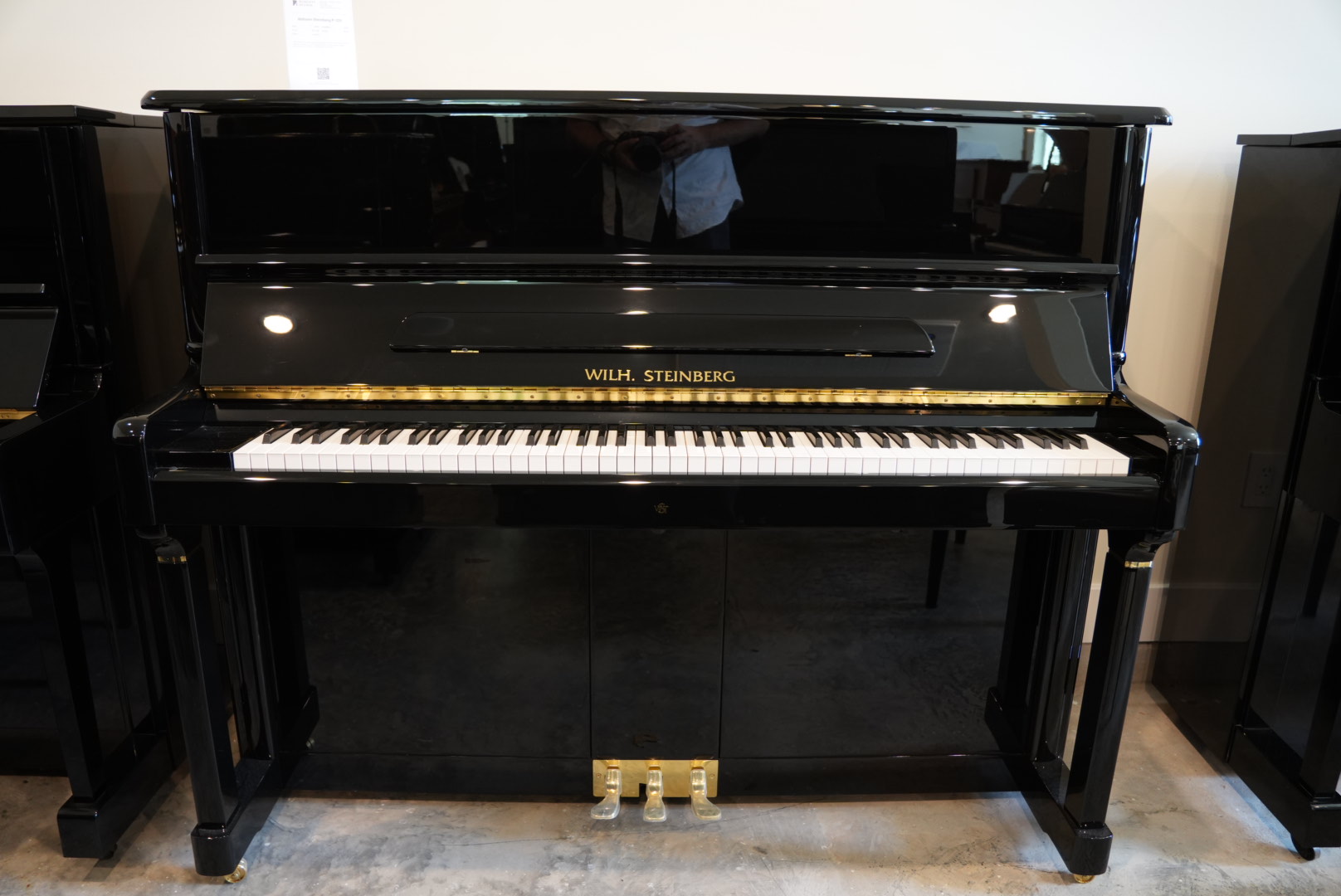
Wilhelm Steinberg P-125
Wilhelm Steinberg
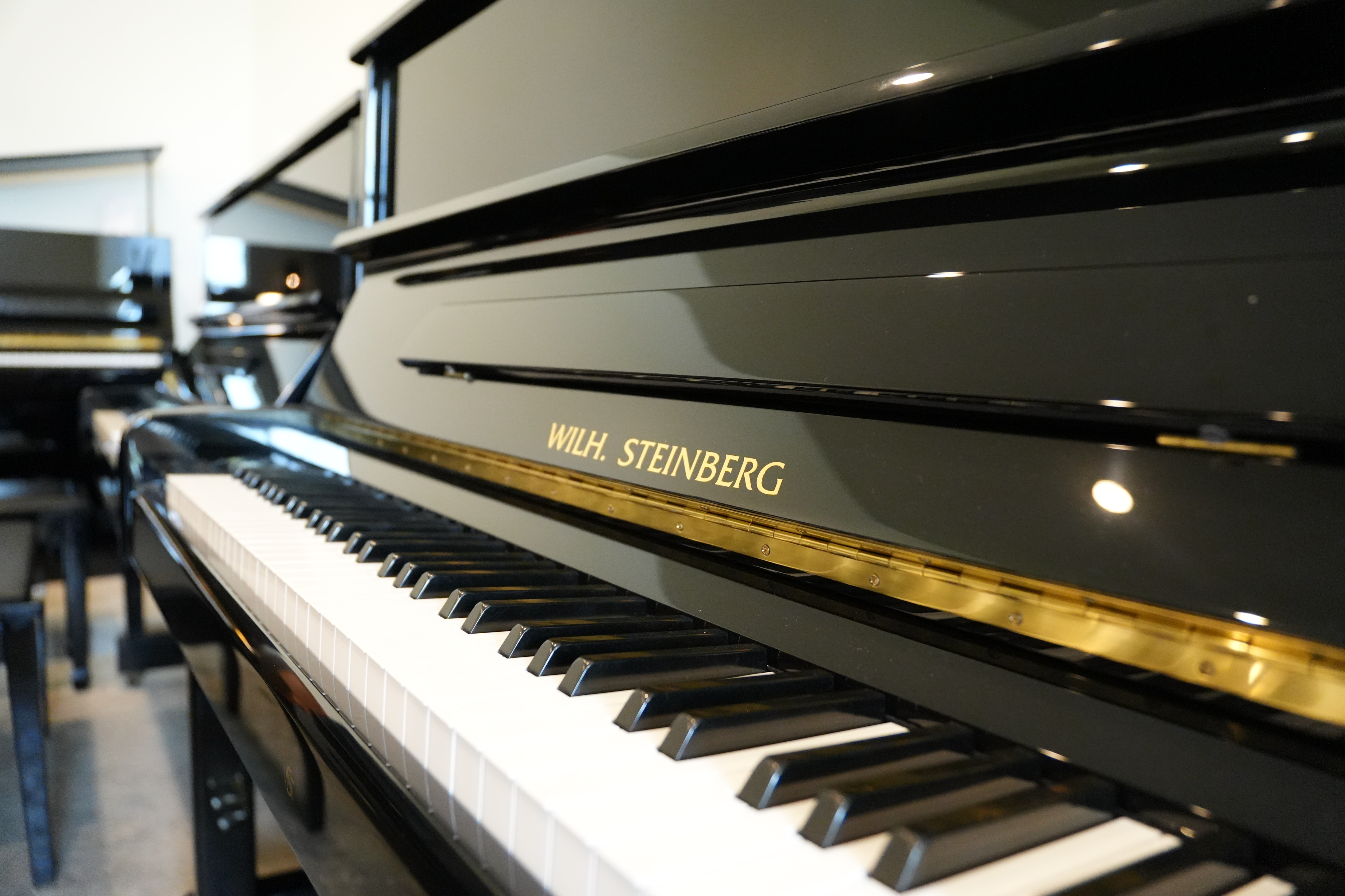
Individual agraffes more common in grand pianos helpful for realigning future new strings
A Piano Maker Shaped by Place, History, and Continuity
A Short Orientation
Wilhelm Steinberg is a piano maker whose story begins not with branding or global strategy, but with place. Its roots lie in Eisenberg, a small town in Thuringia, Germany, where piano making developed gradually through local workshops rather than industrial scale. Over more than a century, the company has existed under different names, economic systems, and ownership structures. What connects these periods is not uninterrupted branding, but continuity of technical knowledge.
Today, Wilhelm Steinberg exists within a modern manufacturing landscape while still drawing from that original tradition. To understand the instruments, it helps to understand how the company arrived here.
Eisenberg and the German Piano Landscape
Eisenberg is not widely known outside piano circles, yet it occupies an important place in German piano history. In the late 19th century, Germany was the world's leading piano-producing nation. Towns such as Leipzig, Bayreuth, and Eisenberg supported clusters of small workshops rather than single dominant factories.
In 1877, Adolph Heinrich Geyer established a piano workshop in Eisenberg. He had trained abroad and returned with technical experience shaped by both European and North American methods. His workshop became one of several in the region, contributing to Eisenberg's emergence as a town where piano making was passed down through apprenticeship and repetition rather than rapid expansion.
By the early 20th century, pianos produced in Eisenberg were being exported and recognized for their stability and musical reliability. This was not a center of radical experimentation, but of refinement and consistency.
War, Nationalization, and Survival
The 20th century brought significant disruption to European piano making. World War II damaged infrastructure, restricted materials, and displaced skilled labor. After the war, Eisenberg became part of East Germany, and private piano firms were nationalized.
The Eisenberg factory was absorbed into a state-run enterprise. Individual brand identities disappeared, but production continued. Pianos were still built, technicians were still trained, and established methods were preserved. This period is significant because it explains why Eisenberg retained piano-making competence when many other regions lost it entirely.
The continuity was institutional rather than commercial, but it proved durable.
Reunification and the Wilhelm Steinberg Name
Following German reunification in 1990, state-owned industries were privatized. In 1993, the Eisenberg piano factory was purchased and reorganized as a private company. The name Wilhelm Steinberg was introduced at this stage, following German naming conventions familiar within piano history.
The intent was not to reconstruct a single historical brand, but to re-establish a German piano maker grounded in Eisenberg's accumulated technical tradition. Production continued in Thuringia at a modest scale, emphasizing craftsmanship rather than volume.
During this period, Wilhelm Steinberg became known as a smaller German manufacturer producing serious instruments without aiming for mass-market dominance.
Production Today: Germany and China
Modern piano manufacturing operates across borders. Wilhelm Steinberg reflects this reality through a clearly divided production structure.
Signature Series
The Signature Series is built in Eisenberg, Germany. These instruments are produced in limited numbers and use established European components, including Renner actions and traditional spruce soundboards. Assembly, scaling, and tonal finishing are carried out by technicians trained within the German system.
These pianos represent the most direct continuation of Eisenberg's historical piano-making practice.
P Series
The P Series is manufactured in China under the ownership of Parsons Music. The designs originate from the German factory, while production takes place in larger, modern facilities.
This separation is structural and transparent. The P Series exists to offer Wilhelm Steinberg designs at a lower price point while maintaining consistency in layout, scaling, and function. It reflects current global manufacturing realities rather than a shift in identity.
Parsons Music: Ownership and Context
Parsons Music is a family-owned music company founded in Hong Kong in the 1980s. Its involvement with Wilhelm Steinberg reflects a broader trend in which Asian firms invested in European piano manufacturers that retained technical expertise but lacked scale.
Parsons did not replace the Eisenberg factory, nor did it relocate German production. Eisenberg continues to function as a manufacturing site, particularly for higher-level instruments. The relationship is best understood as shared ownership with parallel production, rather than as a transfer of identity.
Parsons' wider activities include music education, retail, and piano manufacturing, indicating a long-term engagement with the piano industry rather than short-term brand acquisition.
Where Wilhelm Steinberg Stands Today
Wilhelm Steinberg occupies a position that is increasingly uncommon in the piano world:
- historically rooted
- technically conservative
- neither mass-market nor luxury-focused
Its German-made instruments appeal to players who value balance, stability, and traditional construction. The P Series serves homes, studios, and institutions seeking a well-designed piano without entering the highest price tiers.
The company is not defined by scale or innovation-driven marketing, but by continuity. It has persisted through political change, economic restructuring, and global manufacturing shifts without abandoning its identity as a piano maker connected to Eisenberg.
That places Wilhelm Steinberg within a quieter, longer tradition of piano history — one shaped less by prominence than by endurance.
Photos from our Wilhelm Steinberg pianos
Wilhelm Steinberg P-125
Individual agraffes more common in grand pianos helpful for realigning future new strings
Disclaimer: The information provided on this page is for general informational purposes only. While we strive to provide accurate and up-to-date information about piano manufacturers, we make no representations or warranties of any kind, express or implied, about the completeness, accuracy, reliability, suitability, or availability of the information contained herein. Any reliance you place on such information is strictly at your own risk. The views and opinions expressed are those of the author and do not necessarily reflect the official policy or position of Roberts Pianos Houston or any manufacturer mentioned. We are not affiliated with, endorsed by, or sponsored by any piano manufacturer unless explicitly stated.
Models and origins
| Model | Origin | Range |
|---|---|---|
| P-125 | China | — |
Current & previously sold Wilhelm Steinberg
Videos of Wilhelm Steinberg pianos we've had in stock
Models we've stocked
View details, history, and reviews for each model where we have photos.